 Net
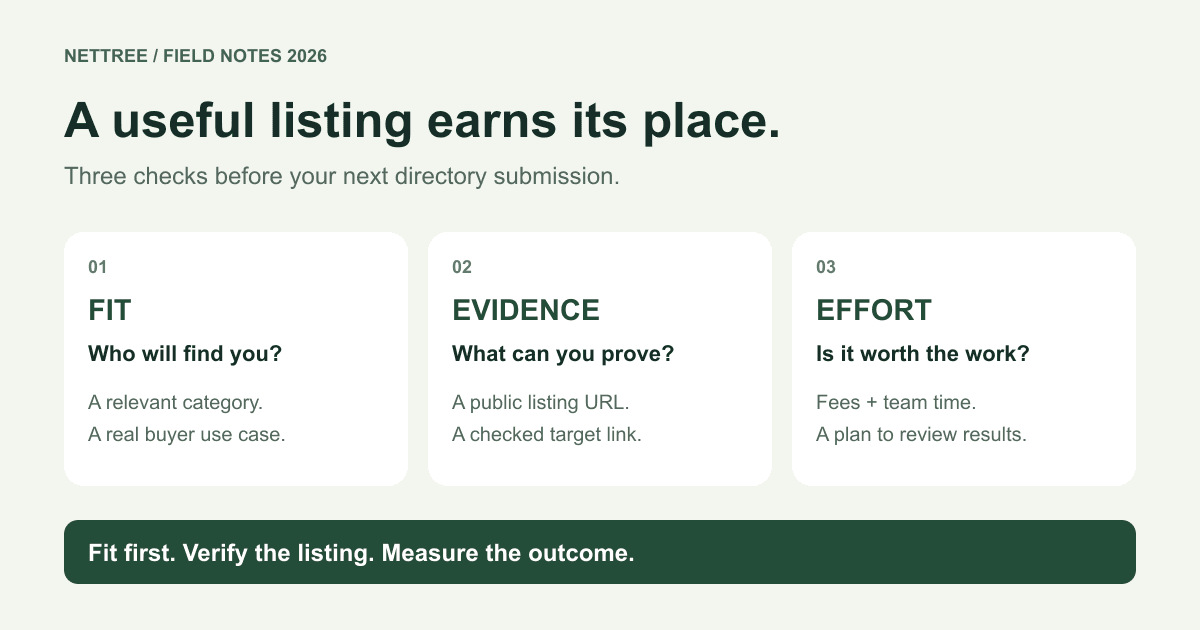
Yes—selectively. For SaaS founders and marketers, directory submissions are worth testing when a platform serves your buyers, accepts your product, and offers a useful public listing. They are a poor investment when the deliverable is hundreds of submissions with no evidence of relevant visitors or published links. Treat directories as a distribution experiment, with ranking gains left unpromised.
The decision comes down to three questions: Does it fit? Can you verify the result? Is it worth the effort? This guide gives you a screening checklist, a worked example, and a way to measure outcomes.
Last updated: November 2, 2026. Reviewed against Google's link policies, AlternativeTo's FAQ, and NetTree's published workflow and plan limits.
What counts as a directory submission?
A directory submission is a request to add your product to a third-party catalog, launch platform, or software review site, usually with a description and website link. These destinations serve different purposes:
| Destination type | Useful when | What to inspect before submitting |
|---|---|---|
| Launch platform | You have a timely release and can support a launch | Current launch rules, audience, and preparation required |
| Niche software catalog | Buyers browse your category or compare alternatives | Relevant categories, useful product pages, and eligibility |
| Software review platform | Prospects need detailed comparisons and credible user feedback | Category fit, profile requirements, and review policies |
| General submission directory | There is a demonstrable audience for your listing | Actual browsing experience, maintenance, and editorial standards |
Product Hunt, AlternativeTo, and G2 illustrate different destination types; they are not a mandatory submission sequence. Check each platform's current rules before making a plan. An established brand name does not establish eligibility for your particular product.
If you already know where to submit, use the directory submission workflow for preparation and recordkeeping. This article helps you decide whether a destination deserves that effort.
Are directory links good for SEO—and can Google penalize them?
There is no blanket answer based on the word “directory.” Google's link spam policy identifies low-quality directory or bookmark links, automated link creation, and buying links for ranking purposes as examples of link spam. The relevant distinction is purpose and quality, rather than the label attached to the website.
Our recommendation is to choose destinations you would still want to appear on if ranking credit were unavailable. That is an editorial screening rule, not a Google certification or a guarantee of safety. A directory's review process alone cannot prove that a particular listing will improve rankings.
For paid placements, Google's outbound-link guidance prefers rel="sponsored"; nofollow remains acceptable. An ordinary editorial link does not require a special rel attribute under that guidance.
Be especially cautious about offers selling guaranteed followed links, keyword-rich anchors, or ranking improvements across unrelated sites. Payment for a legitimate advertising placement is a different proposition from buying ranking credit.
When a directory listing is worth testing
A useful listing has a clear job. Decide which job you are paying for before you submit:
- Relevant discovery: someone browsing your category can recognize your product as a plausible solution.
- Buyer evaluation: a prospect can find accurate details, screenshots, pricing context, or genuine reviews.
- Launch distribution: the platform offers a suitable place to explain a meaningful release.
- A maintained third-party profile: buyers can check your product information somewhere beyond your own website.
These are potential benefits, not promised outcomes. A public profile is not evidence that people saw it, clicked through, or became customers. Likewise, a directory mention alone does not establish that an AI search engine will cite your business.
For AI products, the AI directory selection resource is a starting point for research. Apply the same fit checks to every candidate rather than treating inclusion in a list as an endorsement.
A practical checklist: submit, investigate, or skip
Use the table below before creating an account or paying a fee. This is our editorial framework, not a validated ranking model. A serious policy or eligibility problem outweighs otherwise attractive signals.
| Check | Submit when | Investigate when | Skip when |
|---|---|---|---|
| Buyer fit | A specific category matches your users and use case | Category exists, but the audience is unclear | You cannot explain who would discover you there |
| Eligibility | Current rules explicitly accommodate your product | Rules are ambiguous or appear outdated | Your product is excluded |
| Listing quality | Sample pages contain useful, accurate product information | Pages are sparse or inconsistently maintained | Pages are mostly unrelated promotional links |
| Terms and cost | Fee, renewal, placement, and update terms are clear | You cannot tell what payment buys | The offer promises ranking manipulation |
| Public evidence | A successful listing has a stable public URL and visible website link | The outbound link or public access is unclear | Only a private dashboard or completion report is offered |
| Effort and maintenance | Someone can prepare, verify, and maintain the profile | Follow-up work has no owner | The effort crowds out a stronger acquisition opportunity |
Submit when the important checks pass. Investigate when a missing fact could change the decision. Skip when there is a clear mismatch or unacceptable terms. Unknown traffic, acceptance rates, or link treatment should stay unknown until you have evidence.
Inspect several actual product pages, not just the directory homepage. Follow the browsing path a buyer would take. Check whether descriptions are useful, website links work, and listings can be corrected. A third-party authority score can add context, but it cannot answer those questions for you.
Worked example: choosing a directory for a support SaaS
Suppose you sell customer-support software to small ecommerce teams. These candidates are hypothetical, and the decisions below illustrate the framework rather than report measured results.
| Candidate | Evidence available | Decision |
|---|---|---|
| A catalog with a customer-support category | Comparable products have detailed public profiles; your product meets the rules | Shortlist; confirm terms and website-link treatment |
| A launch platform | Suitable audience, but your release and demo are not ready | Defer until you can support the launch |
| A bulk package promising hundreds of followed links | No destination list, sample listings, or buyer-fit explanation | Skip |
The first candidate is worth a small test because the intended buyer journey makes sense. It still has to earn continued effort through results. The second could be useful later; “not now” is a valid decision. The third fails before any debate about authority scores is necessary.
Are nofollow directory listings worth it?
They can be, if discovery or buyer evaluation justifies the work. A link attribute is one property of a listing; it does not tell you whether the page attracts your buyers. Do not promise ranking credit from a nofollow placement, and do not assume a followed link guarantees useful traffic or better rankings.
A concrete example: AlternativeTo's FAQ says links to apps' websites are normally nofollow unless its editors decide otherwise. Paying for priority review does not buy a followed link or approval; it changes review priority. That makes “pay to be reviewed” different from “pay to receive an SEO backlink.”
Check eligibility before spending time there, too. The same FAQ excludes various product types and emphasizes that approval remains discretionary. A platform's existing listings are not a promise that a similar new submission will be accepted.
How many directories should you submit to?
There is no useful universal quota. Start with a shortlist small enough that you can review every destination and follow up on every submission. Expand only when the work produces outcomes that matter to your business.
For an initial experiment, record your goal and review date before you begin. Choose whether you are testing qualified referral visits, signups, useful buyer profiles, or launch discovery. A backlink check is appropriate for confirming link presence; it cannot measure all of those goals.
Compare the total effort with other uses of the same budget: improving a comparison page, publishing a useful integration tutorial, or developing a relevant partnership. A free listing still costs preparation and maintenance time.
Calculate cost before calling a listing “free”
Use this planning formula:
Total listing cost = placement fees + (research, preparation, submission, and follow-up hours × your internal hourly cost).
For example, assume a shortlist takes three hours of work, your planning rate is $50 per hour, and one review fee costs $40. The experiment costs $190. Those are illustrative assumptions, not directory prices or a performance forecast.
If that experiment later produces two attributable signups, the observed cost is $95 per signup—not $95 per paying customer. If it produces none, record that result and decide whether the profile has another defensible purpose. Use your own customer economics and an appropriate observation window before renewing a paid placement.
After submitting: separate activity from evidence
A submission receipt confirms an action. A public page confirms publication. A backlink check answers a narrower question: whether the intended target link was found at a particular time.
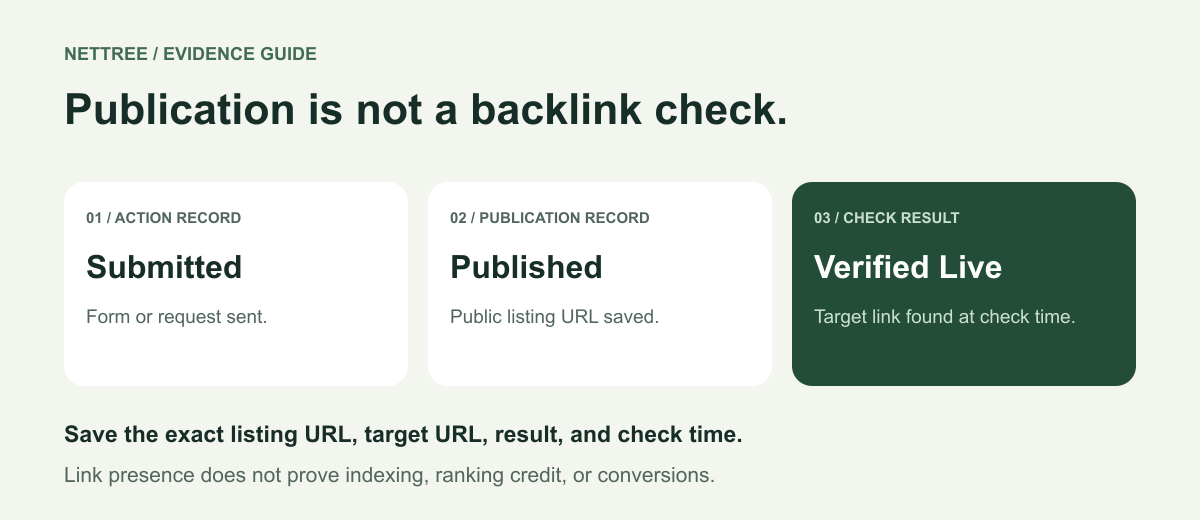
Keep two fields rather than forcing everything into a single success label:
| Record | Example value | What it establishes |
|---|---|---|
| Submission or publication record | Submitted | Your team sent the form or request |
| Submission or publication record | Published | A public listing URL has been recorded |
| Backlink check result | Verified Live | The intended target link was found at the check time |
| Backlink check result | Lost | A previously verified target link is no longer found as expected |
| Backlink check result | Checking / review needed | Evidence is pending, incomplete, or ambiguous |
A listing can be Published while its backlink remains unverified. In NetTree, marking a task Published or saving its URL does not itself run a backlink check. See the verification guide for the evidence requirements and limitations.
For each listing, save the exact public URL, intended target URL, submission date, check result, check time, and next review date. Record link attributes separately. If a check is blocked or ambiguous, inspect it before declaring the link lost.
For marketing outcomes, track referral visits and relevant conversions separately from link presence. Use campaign parameters only where a platform permits them; AlternativeTo's FAQ generally disallows them on the official website link. Referrer-based reporting can help, but attribution will still be incomplete.
Download the submission and acceptance CSV worksheet to keep these records together. It is a recordkeeping worksheet, not a NetTree Tracker import file.
Should you use a spreadsheet, a service, or NetTree?
A spreadsheet can be enough for a handful of known destinations. A service can save execution time if you agree on selection criteria, approved destinations, fees, and delivery evidence before work begins. Require public listing URLs and distinguish pending submissions from published results. No provider can guarantee independent platforms will approve your product.
NetTree fits teams that want site context, destination research, editable submission drafts, and link checks in one workflow. You review the fit and prepare materials; your team handles accounts, CAPTCHAs, platform rules, and final submission. NetTree does not auto-submit.
As listed on NetTree pricing when reviewed on November 2, 2026, Free includes one site, one seat, 10 AI drafts per month, 10 link checks per month, and a limited public library preview. Rechecks use the same check allowance; 10 checks do not mean 10 approved listings or guaranteed backlinks.
If that workflow matches your needs, start a free site profile and qualify a small queue. Choose the method based on the work you need to manage, then judge the experiment by evidence rather than submission volume.
FAQ
Can directory submissions improve rankings?
A submission alone proves neither publication nor ranking impact. Evaluate the destination's relevance and policies, verify the listing, and measure business outcomes. Do not buy a package on the assumption that a promised link count translates into rankings.
Should I pay for a directory listing?
Consider paying when the audience, deliverable, terms, and total cost make sense. Confirm whether the fee covers review, publication, advertising, or renewal. Do not confuse a review fee with guaranteed acceptance or ranking credit.
Does every directory need to offer a followed link?
No. A nofollow listing may still support discovery or buyer evaluation. Decide whether that purpose justifies the effort without assigning it an invented SEO value.
Is a bulk submission package always spam?
Volume alone does not settle the question. Inspect the destinations, purpose, execution, and evidence. Reject ranking-manipulation promises and indiscriminate link creation. A selective service with clear deliverables is a different offer from an unreviewed list of hundreds of sites.
Does Verified Live mean Google indexed or credited the link?
No. It means the intended target link was found at the recorded check time. It does not prove search indexing, ranking credit, referral traffic, or permanent availability.